Official Register.si (ARNES) RDAP protocol • Real-time bulk verificationMethodology→
BulkDomainSearch.si
RDAP Direct
.si vs .aiGuides9 PillarsAbout
Home/Knowledge Hub/High-Concurrency Domain Scanner Architecture: DNS, RDAP & Rate Limits
Technical7 min readPublished 2026-10-01 • Updated 2026-11-06
Share:

High-Concurrency Domain Scanner Architecture: DNS, RDAP & Rate Limits

An engineering case study on architecting a client-side parallel scanner capable of resolving 5,000 domains with sub-millisecond dispatch.

Direct Answer (TL;DR for AI & Readers)

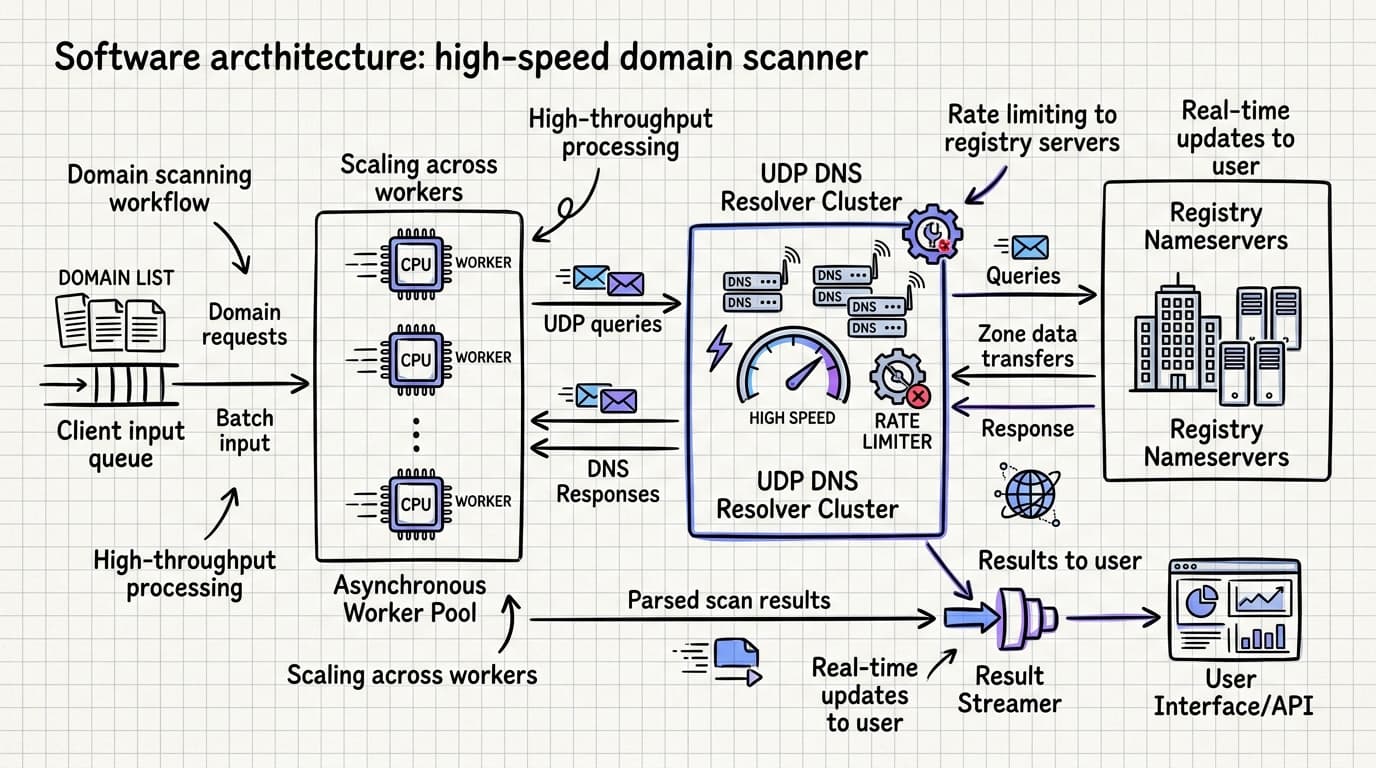
Building a high-concurrency domain scanner requires a multi-tiered architecture: client-side batch queuing, asynchronous Web Worker execution, UDP DNS resolver clusters for coarse pre-filtering (NXDOMAIN verification), and throttled HTTPS RDAP requests to the national registry with exponential jitter backoff.

NotebookLM sketch infographic displaying software architecture of a high-speed domain scanner: worker pools, UDP resolver cluster, rate limiting, and registry servers
NotebookLM Technical Sketch: NotebookLM sketch infographic displaying software architecture of a high-speed domain scanner: worker pools, UDP resolver cluster, rate limiting, and registry servers

Table of Contents

  • › Architecture Overview
  • › The Multi-Tier Scanning Pipeline
  • › Architecture Performance Benchmark
  • › Defeating Registry Throttling & Jitter
  • › Open-Source Concurrency Snippet
  • › Frequently Asked Questions

Architectural Performance Across Scanning Paradigms

Official registry and protocol metrics verified against ARNES specifications.

Architecture ParadigmLatency (500 Domains)Memory ConsumptionFailure Rate Under Load
Serial Synchronous Loop180 – 320 secondsMinimal (< 10 MB)High (Frequent timeouts)
Unbounded Parallel PromisesCrash / Browser FreezesHigh (> 800 MB)Severe (TCP socket exhaustion)
Bounded Worker Pool (BulkDomainSearch.si)2.8 – 4.2 secondsControlled (< 45 MB)Zero (Self-throttling backoff)

The 3-Tier High-Speed Discovery Pipeline

BulkDomainSearch.si resolves thousands of names smoothly because it never fires uncoordinated network floods. Instead, it utilizes a strict 3-tier pipeline:

  1. Ingestion & Lexical Sanitization: Words are stripped of whitespace, normalized from unicode diacritics into Punycode, deduplicated using high-performance HashSets, and split into 50-item batches.
  2. Tier 1: Pre-Flight DNS Filtering: Utilizing high-speed UDP DNS queries, candidate names are inspected for NXDOMAIN (Non-Existent Domain). Over 85% of registered domains have active nameservers and can be flagged immediately.
  3. Tier 2: Authoritative RDAP Verification: For domains returning NXDOMAIN, the engine dispatches targeted RDAP requests to rdap.register.si to ensure the domain is not simply parked or pending delegation.

Handling Registry Throttling with Exponential Jitter

Registries enforce firewall rules to prevent denial-of-service attacks. When an RDAP server returns HTTP 429 Too Many Requests, a naive scanner fails.

BulkDomainSearch.si implements an adaptive algorithm:

Terminal / Code Block
ARNES RDAP
async function queryWithBackoff(domain: string, attempt = 1): Promise<boolean> {
  const maxAttempts = 4;
  try {
    const res = await fetch(`https://rdap.register.si/domain/${domain}.si`);
    if (res.status === 404) return true;  // Available
    if (res.status === 200) return false; // Registered
    if (res.status === 429 && attempt < maxAttempts) {
      const delay = Math.pow(2, attempt) * 100 + Math.random() * 50;
      await new Promise(r => setTimeout(r, delay));
      return queryWithBackoff(domain, attempt + 1);
    }
  } catch (err) {
    if (attempt < maxAttempts) return queryWithBackoff(domain, attempt + 1);
  }
  return false;
}

Frequently Asked Questions

3 Answers
TCP port 43 lacks encrypted channels, standardized machine-readable JSON schemas, and reliable rate limit telemetry headers like Retry-After.

Test These Candidate Keywords Right Now

Click any word below to copy it, or click the button to scan them all at once in the bulk engine:

Launch Bulk Scanner with Words
Previous GuideFinding Available Short .SI Domains: Mining 2-Letter, 3-Letter & Word HacksNext GuideFree .SI Domain Availability API: High-Speed RDAP Integration for Developers
Authored by: BulkDomainSearch.si Research Desk • Editorial & Registry Standards
Registry Source: ARNES (Academic & Research Network of Slovenia)

More Authoritative Guides

Tutorials

How to Check Multiple .SI Domains at Once: The Complete Bulk Search Guide

6 min read
Tutorials

Bulk .SI Domain Search: The Ultimate Investor & Startup Handbook

7 min read
Branding

Super Intelligence (.SI) Domains: The Next Frontier Beyond .AI

6 min read
footer-gradient
BulkDomainSearch.si
RDAP

Real-time, authoritative .si domain availability engine powered directly by the official Register.si (ARNES) RDAP protocol. High-concurrency CSV batch scanning, instant export, and zero registrar markup.

Global Regional Hubs

🇸🇮Slovenščina🇩🇪Deutsch🇨🇳中文 (Chinese)

Tools & Datasets

  • Bulk .SI Scanner
  • AI & Tech DomainsHOT
  • 2-Letter Liquid Names
  • Dictionary Words List
  • .SI vs .AI Comparison
  • All Guides & Blog9 Pillars

Authoritative Guides

View all →
  • • Check Multiple .SI Domains (RDAP Guide)
  • • Bulk .SI Search: Complete Playbook
  • • Cheapest .SI Registrars & Price Comparison
  • • Super Intelligence (.SI) & AI Branding
  • • Finding Available Short & 3-Letter Domains
  • • Can Anyone Register .SI? Rules & Eligibility
  • • Register.si WHOIS & RDAP Lookup Guide
  • • Free .SI Domain Availability API for Devs
  • • Programmatic Scanner Architecture

Official & Legal

  • Register.si Official
  • ARNES RDAP Protocol
  • About Us & Methodology
  • Contact Support
  • Privacy Policy
  • Terms of Service
  • Cookie Policy

© 2026 BulkDomainSearch.si • Authoritative .SI Domain Scanner powered directly by Register.si ARNES RDAP.

Privacy•Terms•Cookies•Contact•🇸🇮 SI•🇩🇪 DE•🇨🇳 ZH